Showing posts sorted by relevance for query "dock boggs". Sort by date Show all posts

25 May, 2010

"Sugar Baby" - "Dock" Boggs


Set Three: Songs; Disc One; Track Six: "Sugar Baby" perfor1med by "Dock" Boggs. "Vocal solo and 5-string banjo, with guitar by Hub Mahaffy." Recorded in New York on March 9, 1927. Original issue Brunswick 118B(01).

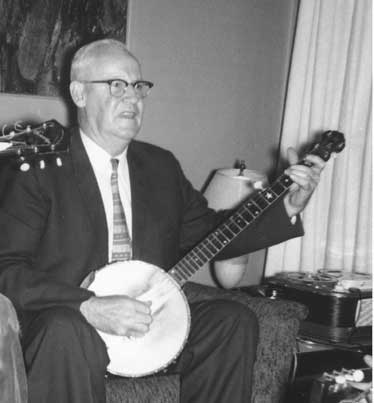
Moran Lee Boggs was born in West Norton, Virgina on February 7, 1898, the youngest of ten children. His nickname, "Dock," was reportedly given to him because of his resemblance to the local physician. His father, a carpenter and blacksmith, taught his children music from an early age. As a small boy, Boggs came under the influence of an African-American guitarist known only as "Go Lightning." In interviews with Mike Seeger, Boggs recalled how he followed "Go Lightning" around, hoping he would stop and play for change. Boggs also recalled sneaking into the African-American mining settlements to listen to string-bands. He became enamored of the African-American style of banjo picking, which differed from the frailing style he had learned from his siblings.

As an adult, Boggs worked as a coal miner, but he continued to play the banjo, learning songs from his siblings, as well as from local musicians. Around 1918 he is believed to have started performing publicly at parties.

Around 1927, Boggs auditioned for Brunswick records. Although nervous enough to require whiskey to calm him down and performing on a borrowed instrument, Boggs passed the audition and traveled to New York to record eight sides, including "Sugar Baby" and "Country Blues," both of which appear on the Anthology. The success of the records allowed Boggs to quit mining and work exclusively as a musician, performing at parties and in mining camps.

In 1929, Boggs traveled to Chicago for a recording session for Lonesome Ace Records. The records failed to sell, however, and a subsequent audition for Okeh did not result in a contract. Between the Depression and the objection of Boggs' wife and neighbors, Boggs decided to pawn his banjo and give up music forever. He returned to coal mining, which he did until his retirement in 1952.

With the release of the Anthology, Boggs' music found a new audience, and in 1963 he was contacted by Mike Seeger. Coincidentally, Boggs had taken up the banjo again and had been practicing for several months before his rediscovery. Boggs went on to record three albums for Folkways Records and perform in clubs and at folk music festivals. He died on February 7, 1971, his 73rd birthday.

In 1968, Jack Wright, a protege of Boggs', started the Dock Boggs Festival which is held annually in Norton, Virginia.

Boggs' entire recorded output can be heard on just two CD collections: Country Blues: Complete Early Recordings on Revenant and Dock Boggs: His Folkways Years on Smithsonian-Folkways. Both are highly recommended.

Like "James Alley Blues," "Sugar Baby" is the lament of henpecked man.

Oh, I've got no sugar baby now.
All I can do for seek peace with you,
And I can't get along this a-way.
Can't get along this a-way.

All I can do, I've said all I can say.
I'll send it to your mama next payday.
Send you to your mama next payday.

Got no use for the red rockin' chair,
I've got no honey baby now.
Got no sugar baby now.

Who'll rock the cradle, who'll sing the song?
Who'll rock the cradle when I'm gone?

I'll rock the cradle, I'll sing the song.
I'll rock the cradle when you gone.

It's all I can do, said all I can say.
I will send you to your mama next payday.

Laid her in the shade, give her every dime I made.
What more could a poor boy do?

Oh, I've got no honey baby now.
Got no sugar baby now.

Said all I can say, I've done all I can do,
And I can't make a living with you.
Can't make a living with you.


Greil Marcus, in his Invisible Republic, makes much of this song and of Boggs. He describes Boggs as a man who "sounds like his bones are coming through his skin" when he sings. Marcus also makes "Sugar Baby" sound particularly sinister. At one point, Marcus singles out the following stanzas:

Who'll rock the cradle, who'll sing the song?
Who'll rock the cradle when I'm gone?

I'll rock the cradle, I'll sing the song.
I'll rock the cradle when you gone.


To Marcus, the answering voice ("I'll rock the cradle") is terrifying and unearthly. It is at this point that Marcus's romanticism gets the better of him.

A close reading of the lyrics to "Sugar Baby" reveals nothing sinister or supernatural whatsoever. The song is told from the point of view of a man who has had enough of his wife. He describes how he "gave her every dime [he] made" and yet he "can't make a living with [her]". He plans to send his wife back to her mother "next payday."

The question about "rock[ing] the cradle" is asked by the wife when she is threatened with being sent away. "Who will look after the children?" she asks, to which the husband simply replies, "I will."

Marcus's supernatural reading of "Sugar Baby" is, in large measure, influenced by Boggs' performance. It is undeniable that Boggs has an unusual voice. He seems to strangle each word in his throat as he sings it. Yet when one listens to the recordings of Boggs from the early '60s, it becomes clear that Boggs' voice isn't so odd. Certain nuances of his voice are clearly absent from his 1927 recordings, likely due to the relatively primitive recording techniques. Captured on magnetic tape using more sensitive and sophisticated recording equipment, Boggs' voice loses much of its uncanny quality.

Like "The Coo Coo Bird" and "East Virginia," "Sugar Baby" seems creepy because it is performed on the banjo in a minor key. This quality is enhanced on this particular recording due to Boggs' unusual banjo technique. The style he played is called "up-picking," which involves picking upwards on the first two strings and playing one of the other three strings with the thumb.

Two interesting miscellaneous notes about "Sugar Baby": "Sugar Baby" was recorded on March 9, 1927, exactly two days before Rabbit Brown recorded "James Alley Blues."

"Sugar Baby's" label contains a rare instance of crediting a musician other than the recording artist. The label (and Smith's subsequent entry in the liner notes) credits one Hub Mahaffy as the guitar player on this recording. Who was Hub Mahaffy? Nothing is known of him, other than the fact that he accompanied Boggs on this session.

The Shameless Plug Department: The sixth episode of the "Where Dead Voices Gather" podcast is finally up! It's an all fiddle episode featuring fiddle tunes from both black and white artists, as well as three tracks from the Middle East! Also available on iTunes! Subscribe today so you don't miss a single episode. It's free and it doesn't hurt. Who can ask for more?

You can also become a fan of "Where Dead Voices Gather" on Facebook and follow us on Twitter. Where Dead Voices Gather: Using today's technology to promote yesterday's music!

I would like to announce that beginning May 9, 2010, I will be hosting "Doin' The Thing," a weekly jazz program on KRML 1410 AM and 94.7 FM in Carmel, California. The show airs from 8 PM to 10PM (Pacific Time) on Sunday nights. You can also listen online by visiting the KRML website at 8 PM Pacific, 11 PM Eastern Time. Please tune in and give me feedback!

Here's a video of "Sugar Baby" performed on fiddle and (off camera) banjo. The fiddle and vocal are by the author of the wonderful Old Weird America blog!


Here's a more modern reading by the Indaba Harry Smith Project, featuring Dale Crowley on keyboards, Jussi Salminen on electric and acoustic guitar and banjo,
Scott Swatzell on drums and vocal, and Mike Tobin on bass.


Download and listen to Dock Boggs - "Sugar Baby"

04 July, 2010

"Country Blues" - "Dock" Boggs


Set Three: Songs; Disc Two; Track Three: "Country Blues" performed by "Dock" Boggs. "Vocal solo with banjo." Recorded in New York on March 9, 1927. Original issue Brunswick 131A (96).

For biographical information on Dock Boggs, see the entry for "Sugar Baby."


Come all you good time people,
While I've got money to spend,
Tomorrow might be Monday
And I'll neither have a dollar nor a friend.

When I had plenty of money, good people,
My friends were all standing around,
Just as soon as my pocket book was empty,
Not a friend on earth to be found.

Last time I seen my little woman, good people,
She had a wine glass in her hand;
She was drinking down her troubles
With a low-down sorry man.

Oh, my daddy taught me a-plenty, good people;
My mama, she taught me more.
If I didn't quit my rowdy ways,
Have trouble at my door.

I wrote my woman a letter, good people;
I told her I's in jail.
She wrote me back an answer
Saying "Honey, I'm a-coming to go your bail."

All around this old jailhouse is hainted, good people;
Forty dollars won't pay my fine.
Corn whisky has surrounded my body, poor boy,
Pretty women is a-troubling my mind.

Give me corn bread when I'm hungry, good people;
Corn whiskey when I'm dry;
Pretty women a-standing around me;
Sweet heaven when I die.

If I'd a-listened to my mama, good people,
I wouldn't have been here today;
But a-drinking and a-shooting and a-gambling,
At home I cannot stay.

Go dig a hole in the meadow, good people,
Go did a hole in the ground.
Come around all you good people
And see this poor rounder go down.

When I am dead and buried
My pale face turned to the sun,
You can come around and mourn, little woman,
And think the way you have done.


"Country Blues" is a variant of the song "Darling Cora." One version of the lyrics to "Darling Cora" is as follows:

Wake up, wake up, Darlin' Corey.
What makes you sleep so sound?
Them revenue officers a-commin'
For to tear your still-house down.

Well the first time I seen Darlin' Corey
She was settin' by the side of the sea,
With a forty-four strapped across her bosom
And a banjo on her knee.

Dig a hole, dig a hole, in the medder
Dig a hole, in the col' col' groun'
Dig a hole, dig a hole in the medder
Goin' ter lay Darlin' Corey down.

The next time I seen Darlin' Corey
She was standin' in the still-house door
With her shoes and stockin's in her han'
An' her feet all over the floor.

Wake up, wake up Darlin Corey.
Quit hangin' roun` my bed.
Hard likker has ruined my body.
Pretty wimmen has killed me mos' dead.

Wake up, wake up my darlin';
Go do the best you can.
I've got me another woman;
You can get you another man.
Oh yes, oh yes my darlin'
I`ll do the best I can,
But I`ll never take my pleasure
With another gamblin' man.

Don` you hear them blue-birds singin'?
Don` you hear that mournful sound?
They`re preachin' Corey`s funeral
In some lonesome buryin' groun'.


"Country Blues" is the second song in a row to make reference to prison. It is essentially a warning song. The speaker in this song describes himself as a "rounder" who drinks, shoots and gambles. He finds himself in prison and predicts a melancholy end to his dissolute existence. The biggest difference between "Country Blues" and "Darling Cora" is that in "Darling Cora," Cora (a gun-toting, moonshining woman) lives the dissolute life that leads to her death. In "Country Blues" it is the speaker himself. There are several lyrics in "Country Blues," however, that are clearly drawn directly from "Darling Cora."

The burial instructions in "Country Blues" are mirrored in several songs on the Anthology, including "Fatal Flower Garden," "The Butcher's Boy," and "See That My Grave Is Kept Clean."

Boggs is frequently cited as one of the first white performers to fully integrate the blues (a primarily black style in the early days of the 20th century) into his music. While "Country Blues" is certainly not an example of the traditional blues form, it does contain blues themes. One might even argue that by switching the song's point of view to a first person account of the speaker's troubles, Boggs transformed the song from a traditional mountain ballad into something more modern.

The Shameless Plug Department: The sixth episode of the "Where Dead Voices Gather" podcast is finally up! It's an all fiddle episode featuring fiddle tunes from both black and white artists, as well as three tracks from the Middle East! Also available on iTunes! Subscribe today so you don't miss a single episode. It's free and it doesn't hurt. Who can ask for more?

You can also become a fan of "Where Dead Voices Gather" on Facebook and follow us on Twitter. Where Dead Voices Gather: Using today's technology to promote yesterday's music!

Remember that I host "Doin' The Thing," a weekly jazz program on KRML 1410 AM and 94.7 FM in Carmel, California. The show airs from 8 PM to 10PM (Pacific Time) on Sunday nights. You can also listen online by visiting the KRML website at 8 PM Pacific, 11 PM Eastern Time. Please tune in and give me feedback!

Here's a version of "Country Blues" performed on ukulele.


Here's a version of "Darling Cora" performed on banjo.


Download and listen to Dock Boggs - "Country Blues"

10 November, 2009

"The Butcher's Boy (The Railroad Boy)" - Buell Kazee


Set One: Ballads; Disc One; Track Six: "The Butcher's Boy (The Railroad Boy)" performed by Buell Kazee. "Vocal solo with 5-string banjo." Recorded in New York on January 16, 1928. Original issue Brunswick 213A (032).

Buell Kazee was born in Burton's Fork, Kentucky in 1900. Unlike most of the musicians whose recordings were included in the Anthology, Kazee had a formal education. He graduated high school and studied English, Greek, and Latin at Georgetown University. He also received formal musical instruction, which is evident in his precise clawhammer style on the banjo (see the entry on "The House Carpenter" for more information on the origin of the banjo).

"Clawhammer" picking is distinguished from other traditional finger-picking styles (such as the "Scruggs" style) in that it is primarily a down-picking style. The hand is formed in the shape of a claw with the strumming finger kept fairly stiff. The strings are stuck my the movement of the wrist or elbow. "In its most common form on the banjo, only the thumb and middle or index finger are used and the finger always downpicks, hitting the string with the back of the fingernail or a pick." (Wikipedia)

Kazee began recording for Brunswick in 1927, eventually recording 58 songs for the label over the next two years, including this version of "The Butcher's Boy." He ceased recording during the Depression, instead devoting himself to the ministry. The release of the Anthology in 1952 led to his eventual rediscovery and a second career in the late '50s and '60s. He recorded Buell Kazee Sings and Plays for Folkways in 1958. During the '60s, he made numerous appearances at folk festivals (including the Newport Folk Festival), often in the company of fellow Anthology artists like Clarence Ashley and Dock Boggs. In 1975, Kazee was recorded by folklorist Art Rosenbaum. A recording of Kazee performing an instrumental version of "Big Foot Feller" can be heard on the first volume of The Art of Field Recording. He died in 1976.

"The Butcher's Boy" is the first ballad to appear on this set not cataloged by Child. According Smith's notes, the song is an amalgam of "The Cruel Father" and "There Is An Alehouse in Yonder Town." Both songs date to 18th century Britain, but their combination into a single song seems to be a product of America. The song is typically known as a "Broadside ballad." Broadside ballads were popular songs printed on large sheets of paper, folded into pamphlets, and sold by street vendors. The earliest Broadsides did not feature musical notation, but often stated that the song could be sung to another popular tune. Since many early Broadsides were printed using Black Letter type, they are sometimes referred to as "Black Letter Ballads."

"The Butcher's Boy" is also the first ballad on the Anthology cataloged by George Malcolm Laws (b. 1919). Laws is the author of American Balladry from British Broadsides published in 1957. He cataloged a wide range of songs, including songs excluded by Child and those discovered after Child's death. Laws' system is a coded cataloging system which gives each selection a letter and a number. The letters separate the songs by category. A brief example follows:

* J War ballads
* K Ballads of sailors and the sea
* L Ballads of crime and criminals
* M Ballads of family opposition to lovers
* N Ballads of lovers' disguises and tricks
* O Ballads of faithful lovers
* P Unfaithful lovers
* Q Humorous and miscellaneous

The letters A through H indicate ballads that have their origin in America, while J through Q indicate ballads taken from British Broadsides. "The Butcher's Boy" is Laws P24.

"The Butcher's Boy" tells the tragic tale of a young girl who commits suicide after being jilted by her lover. Her father finds her dead body, along with a note dictating her final wishes.


She went upstairs to make her bed,
And not one word to her mother said.
Her mother she went upstairs too,
Says "Daughter, dear daughter, what troubles you?"

"Oh mother, oh mother, I cannot tell,
That Railroad Boy I love so well.
He's courted me my life away,
and now at home he will not stay."

"There is a place in London town,
Where that Railroad Boy goes and sits down.
He takes that strange girl on his knee
And he tells to her what he won’t tell me."

Her father he came in from work
And says, "Where’s daughter? She seems so hurt."
He went upstairs to give her hope
But found her hanging on a rope.

He took his knife and cut her down,
And in her bosom these words he found:

"Go dig my grave both wide and deep.
Place a marble slab at my head and feet.
And over my coffin place a snow white dove
To warn this world that I died for love."


Unlike many of the other ballads on this set, Kazee sings in a highly sentimental style, underlining the tragic nature of the song. Note that while the song is titled "The Butcher's Boy," Kazee refers to the unnamed girl's lover as the "Railroad Boy." On the 1958 Folkways LP, Buell Kazee Sings and Plays, Kazee explains this in the spoken introduction to "The Butcher's Boy":

"The Butcher's Boy," of course, is the original ballad in England and that's the title that is known among people who deal in folk songs a good deal. But in this country, especially in the Kentucky mountains, it became "The Railroad Boy." Railroads, when the railroads began to go up the valley - the Sandy Valley - and east Virgina boarder and all that, became quite a romantic thing to the mountaineer's mind, y'know. They got to singing "railroad," and for instance in that song you have "there is a place in London town where the Butcher's Boy goes and sits down." Well, they sang it, "there is a place in Lebanon town where the Railroad Boy goes and sits down." Well, Lebanon is down here in Kentucky and happens to be a railroad junction, a place where two roads come together, a division is, you see. Well, that probably was known to somebody who sang the song and he got it in there. Well, it had such an influence on me, I sang it all my life as "railroad boy," and I heard my older sister sing that. And when I got to New York to record it, I knew we were going to record "The Butcher's Boy" and we wanted to record "The Butcher's Boy" because that was the way it was known in England, and that's the way its known in America a lot. But in spite of all I could do, even though we called it "The Butcher's Boy," when I got to the verse where it was supposed to be, I called it "the Railroad Boy." (Laughs)

The trope of the dead or dying dictating their last wishes (particularly their burial arrangements) was last heard on this set in "Fatal Flower Garden."

The other side of the Brunswick release of "The Butcher's Boy (The Railroad Boy)" was "The Wagoner's Lad (Loving Nancy)" which appears as the next selection on the Anthology.

I should note that the Anthology has inspired several tribute albums, including the recent Harry Smith Project. This set features a selection of highlights from several all-star concerts at which notable artists (Lou Reed, Beck, Steve Earl, etc.) perform songs from the Anthology. Particularly notable is Elvis Costello's performance of "The Butcher's Boy."


Download and listen to Buell Kazee - The Butcher's Boy (The Railroad Boy)