03 March, 2026

I’m Back! Well, Kinda…

 Oh, hello, The Internet!  I didn’t see you there!  Come on in!  Have a seat.  Just clear off one of those chairs over there.  What’ve you been up to?  Getting worse than ever before?  Jam packed with racists?  Cluttered with AI slop?  Cool, cool.  Hey, how’d that whole “NFT” thing work out for you?  Ouch!  Less said the better, huh?

I see by the old calendar on the desktop that it’s been nearly another six whole years since I updated this blog, which means it’s time for me to climb out of my hole in the ground and give the place a good dusting.  What have I been up to?  Hanging on by my fingernails, just like everybody else!  

Well, maybe I’ve been doing a little more than that.  Mainly, I’ve been thinking.  And when I start thinking, I start writing.  And when I start writing…well, you all saw what happened last time.

I’m still listening to music, including the old Anthology of American Folk Music.  I still listen to it every Fourth of July.  But lately, my thoughts have been getting a little more…how shall one say?  Philosophical?  Up-my-own-ass?  Sounds legit.  

The music Harry Smith collected on the four volumes of the Anthology was the music of the common people and it expressed everything about their lives, even if the recording artists didn’t necessarily write the songs.  Take “No Depression” by The Carter Family.:  “I’m goin’ where there’s no depression/To a lovely land that’s free from care/I’ll leave this world of toil and trouble/My home’s in heaven/I’m goin’ there.”  That longing to escape from the cares of the world is universally recognized.  We’ve all felt it, even if we haven’t expressed it in quite the same way.  For me, the desire to escape this sinful world isn’t about accepting my lot here and dreaming of a better world after death.  If anything, that attitude is the problem, isn’t it?  Leave the world to itself.  God will take care of it eventually.  He’ll separate the sheep from the goats!  What’s God got against goats anyway?  

No, to me the desire to escape from the troubles of the modern world isn’t about hoping for something better later on.  It’s about the desire to do better for ourselves in this world.  To that end, I’ve been tinkering with a concept I call “Abundant Sufficiency”.  It’s the idea that enough exists in the world for everyone to have enough to live with dignity.  I’ve been writing about it and posting to a new blog I’ve set up on this very website!  If you’re interested, you can check it out here:  https://abundantsufficiency29.blogspot.com/

I hope you’ll join me over there.  You can read my half-baked musings and leave me comments telling me what a dirty commie I am!  It’ll be a hoot!  


04 July, 2020

It's The End of the World As We Know It (Happy Fourth Day of July)


I see by the date on my last post that it has been six mortal years since I last posted here.  I have no idea if anyone even reads this thing anymore.  I don't even have a Facebook page or a Twitter feed!

I know that I'm supposed to open this by saying something about "these uncertain times", but the fact of the matter is that all times are uncertain.  The only certainty is uncertainty.

Today is what we in the good ol' blockheaded United States call "Independence Day".  On this day, we normally celebrate vague ideals like "liberty" and "equality" while conveniently ignoring the fact that even on 4 July, 1776, a good chunk of the population of the thirteen colonies hardly knew the meaning of those words, and that it would be nearly a century before we even began to fix that.

Generally speaking, we observe this day with explosions, the eating of various meats, and the drinking of yeasty beverages.  Not me.  I hate fireworks and I quit drinking a year and a half ago.  I will eat the meats, though.

Each year on this day, I celebrate by listening to The Anthology of American Folk Music.  You remember that thing!  That's the thing I talked about on this blog for over a year waaaaaaay back when Barack Obama was President and things made sense!  In fact, I'm listening to it right now, even as I write this.  "The Old Lady and The Devil" is playing.  I urge you to join me on this weirdest of Independence Days by enjoying what Greil Marcus famously called "The Old Weird America" (seriously, he won't shut up about it).

Remember,

The Coo-coo is a pretty bird.
She warbles as she flies.
She never hollers coo-coo
Til the fourth day of July.

All lives can't matter until Black Lives Matter.

Peace,

Alexander

13 November, 2014

Jazz Article in the Albany Times Union


An article I wrote on jazz music in New York's Capital District was the cover story in the Preview section of today's Times Union.  The cover image is a recreation of Art Kane's legendary 1958 photo "A Great Day in Harlem".  We got more than sixty area jazz musicians, photographers, writers, DJs, etc. to come out and pose on the steps of one of the brownstones on Albany's Madison Avenue.  I is quietly proud... 


22 September, 2014

A Call for Responses

For many years I have contemplated writing a book on the Anthology, and now I think the time has finally come.

My proposed title is Changed Through Music:  Why Harry Smith's Anthology of American Folk Music Still Matters.

Now, at this point I'm in the process of writing a few sample chapters and crafting a proposal to send to publishers. However, I do know that I want to have a chapter featuring various perspectives on the title.  So:  I ask YOU - Why does the Anthology still matter?  Tell me in 50 words or less, and the best responses may well make their way into the finished book.  Send your response to alexander1228@gmail.com with the subject line "Why the Anthology Matters".  I look forward to reading your responses!

21 September, 2014

FreshGrass Part II


Here's the review I did for the TU on Saturday's FreshGrass show:

If one word were to sum up the FreshGrass Festival at Mass MoCA, it would be eclectic. The music performed crossed and recrossed genre boundaries. Boston’s the Novel Ideas, for example, played raw, electrifying roots rock laced with country harmonies, while the trio Haas Kowan Tice mashed up traditional string band music with chamber strings to great effect.

Read the whole article by clicking the link below:

FreshGrass Part I


One of the reasons I haven't been posting here lately, apart from general laziness, is that I have recently made the move into the lucrative (ha) field of freelance writing (largely music, but also features, book and theater reviews, etc.). Anyway, here's a piece I did for Thursday's Times Union on the FreshGrass Music Festival in North Adams, MA, which features an interview with Grammy winning banjo player and all around swell gal, Alison Brown:

The spirit of Appalachia will settle in the Berkshires this weekend when the FreshGrass Music Festival hits Mass MoCA for three days of music, heritage and moonshine.

To read the whole article click below:


Be sure to leave a comment so they'll give me more work!


22 September, 2012

Where Dead Voices Gather Went To London!


Well, the UEA conference was a tremendous success.  I showed up a bit late because of London's street signs (they're inconsistent, at best, completely absent at worst), but was in time to hear all of the papers.  For those who care, here is the day's program:

9.00 - 9.30 - Coffee and Registration

9.30 - 9.45 - Welcome - Ross Hair & Thomas Ruys Smith, School of American Studies, University of East Anglia

9.45 - 11.00 - Keynote - Professor Geoff Ward, Royal Holloway, University of London:  '"Spun in a wheel of vertigo":  Harry Smith and the Magic of History'

11.00 - 11.15 - Coffee

11.15 - 13.00 - Volume 1:  Context -

Rani Singh, Director of the Harry Smith Archives, '"America Changed Through Music":  Harry Smith's Anthology of American Folk Music Turns 60'

Rory Crutchfield - University of Glasgow, 'An Act of Cultural Subversion?  Conceits and Critical Responses to the Anthology'

Ross Hair, University of East Anglia, 'Harry Smith, the American Diogenes'

Kurt Gegenhuber, The Celestial Monochord, 'Smith's Amnesia Theater:  "Moonshiner's Dance" in the Context of The Anthology of American Folk Music

13.00 - 13.45 - Lunch

13.45 - 15.00 - Volume 2:  Influence -

James Boaden, University of York, 'Stan Brakhage and Films in the Folk Style'

Phil Langran, University of Lincoln, 'Writing the South:  Harry Smith and the Stories of William Gay'

Paola Ferraro, University of Rome, La Sapienza, 'The New "New Weird America" of U.S. Black Metal:  Returning to Appalachia with Panopticon's Kentucky

15.00 - 15.15 - Volume 3:  Legacy -

Alexander M. Stern, Where Dead Voices Gather, 'Technology and the Anthology:  From Shellac to the Cloud'

Jake Faulkner, California Institute of the Arts, 'Re-envisioning America:  A Multimedia Homage to Harry Smith's Anthology of American Folk Music

16:30 - 18.00 - Music - 'Harry Smith's Anthology of American Folk Music at 60:  A Transatlantic Legacy' featuring performances by Rapunzel & Sedayne and Ewan D. Rodgers

The day was amazing and full of highlights:  Kurt Gegenhuber's enthusiastic presentation, punctuated by repeated exclamations of "What are you gonna do with that cow?  Improvise, Frankie!"; learning about the novels of William Gay, with whom I was not previously familiar and who I plan on reading ASAP; Paola Ferraro's fascinating discussion of the influence of American Folk Music on the new wave of American Death Metal; meeting Rani Singh and listening to her stories about Harry Smith's last years; meeting Jake Faulkner and hearing/seeing the incredible works of art he commissioned for his multimedia project (including an amazing black and white film set to "The Wild Wagoner" that seemed equally influenced by A Hard Day's Night and the cover to The Freewheelin' Bob Dylan); not to mention meeting some incredible people, listening to the free exchange of ideas through the medium of a shared passion, and hearing some truly inspired musical performances.

I must say that of all of the papers, mine was probably the least academic and least scholarly.  It was somewhat daunting to make my relatively simple observations about the Anthology and my experience blogging about it.  Nonetheless, it was an honor to speak on the same stage with all of the others and I was made to feel most welcome.  Many thanks to Ross and Thomas for putting this together.  It was truly the experience of a lifetime.  I would also like to thank everyone who presented.  It was a privilege to hear your ideas and to have an opportunity to speak with you.  Finally, I would like to thank those who attended.  It was a pleasure to meet so many fascinating people.  It was an experience I'll not soon forget.

In addition, I recently discovered that the Financial Times did an article on the conference and the Anthology and this blog got a mention.  Pretty cool!  Check it out...

Below are some videos featuring Rapunzel and Sedayne (aka Rachel McCarron and Sean Breadin) and Ewan D. Rodgers.  


20 June, 2012

Where Dead Voices Gather Goes to London!


Exciting news!  On September 15th I will be presenting a paper at a special, one-day conference on the Anthology:  America Changed Through Music: Harry Smith's Anthology of American Folk Music at 60, hosted by the University of East Anglia's School of American Studies at UEA London.  The title of my proposed paper is "Technology and the Anthology:  From Shellac to the Cloud".  Naturally, my experience writing this blog will be discussed.  Keep an eye on this space for further details!

24 February, 2012

Review - "Dark River: Songs of the Civil War Era, Interpretations By Austin's Finest Musicians"


Before I begin this review, a moment of full disclosure: Chuck Pinnell, guitarist and producer of Dark River is my aunt Suzi's ex-husband and the father of my cousin, René Pinnell (who is a big wheel in the computer world. Look for his apps Hurricane Party and Forecast. Yes, I know...I know. My family is disgustingly accomplished. One day maybe I'll join them. Sigh...). What is the point? The point is twofold: One, yes I was asked by Chuck to check out this CD and was sent a review copy. Two, my relationship to Chuck and Suzi has absolutely no bearing on my opinion of the music. If I think it sucks, I will say so. As it happens, I don't think it sucks...
Nevertheless, I can easily see how one might question my objectivity in this review and think that I'm just using my blog to shill for family, however much I might protest that this isn't the case. Having said all of that, let's get to the music...

Dark River: Songs of the Civil War Era was conceived by producer Chuck Pinell, an Austin based guitarist and composer. According to his liner notes, Chuck came up with the idea for Dark River while working with fellow musician Slaid Cleaves on a film project. Chuck recruited a number of extraordinarily talented musicians to provide interpretations of songs ranging from Stephan Foster's "Hard Times" to the Irish ballad "Johnny Has Gone For A Soldier." The result is an eclectic slice of Americana; bracing as a double shot of bourbon and refreshing as a drink from a cool mountain spring.

The album kicks off, appropriately, with a rollicking version of "Shiloh" or "The Secesh". The alternate title takes its name from the secessionists of central Tennessee who lined up to fight for the Confederacy following the 1862 Battle of Shiloh. The battle was one of the bloodiest of the war: 10,700 Confederates were killed or wounded for no gain whatsoever, while the Union squeaked out a narrow victory at a cost of 13,000 killed or wounded.

"Shiloh" is performed here by fiddler Warren Hood and mandolinist Rich Brotherton. Hood's youthful voice perfectly matches that of the speaker, a brash young man bravely striding into battle following one of the Confederacy's heaviest losses. Instrumentally, the performance is pitch perfect and beautifully recorded. It is an auspicious beginning.

The rest of the album does not disappoint. Each track is unique, providing an original take on some very familiar melodies and featuring magnificent performances. The fact that several musicians show up throughout the album providing instrumental support keeps the album from feeling like a patchwork affair, a hazard of multiple-artist projects. Some highlights:

Drew Nelson's weary reading of "Hard Times", featuring a lovely harmony vocal from Tina Mitchell Wilkins; Rebecca Folsom and Celeste Krenz's angelic performance of the spiritual "Swing Low" (a song I've had particular affection for ever since my mother sang it to me as a lullaby when I was little); two lovely Irish songs performed back to back (in memory of the many Irish lads who were recruited into the Union army, some directly off the boat): Slaid Cleaves gives us a haunting and haunted rendition of "She Moved Through The Fair" while Erin Ivey keens a heartrending lament for her lost love on "Johnny Has Gone For a Soldier", an American version of the traditional "Siúil a Rúin" (with the chorus beautifully sung in Gaelic).

The album features some wonderful instrumentals that really highlight the tightness of this group of musicians: Producer Pinnell's fine reading of "The Last Rose of Summer," Rich Brotherton's version of "The Yellow Rose of Texas" and Jeff Plankenhorn, whose lovely dobro enlivens his version of "Home Sweet Home" (a song which also appeared on the Anthology ).

I would be remiss if I did not mention my own dear aunt, Suzi Stern. It was Suzi who hipped Chuck to Where Dead Voices Gather and suggested that he might contact me for a review. Suzi is also the artist on Dark River with whom I am most familiar (we lived in the same house for the first several years of my life, for cryin' out loud). So I may, again, sound biased when I say that Suzi's contribution to Dark River is a stand-out. Suzi performs a version of the minstrel show standard "Oh! Susanna" that makes the hair on your arms stand on end. While most of artists on Dark River are solidly within the bounds of folk, country, and traditional music, Suzi is a jazz musician. Her arrangement of "Oh! Susanna", which features her piano playing as well as her vocal, perfectly blends modern jazz with American Folk Music (and there is an argument to be made that jazz is as much a "folk" music as blues, but that's another post). Leah Zeger's fiddle provides a gentle counterpoint to the rubato piano line laid down by Suzi, while Chuck plunks a mean banjo, in addition to his contribution as a guitarist. Suzi holds off on the familiar "don't you cry for me" chorus, creating a tension that builds throughout the performance. It is, truly, a highlight on an album of highlights.

I don't mean to slight any of the other performances from artists like Jimmy LaFave, Jon Dee Graham, Eliza Gilkyson, James McMurtry, and Rita Hosking, all of whom are wonderful and enliven their contributions with their own unique styles. There's just too much great music to go into detail about each track. I heartily recommend Dark River: Songs of the Civil War Era to all lovers of American music, past and present.

Here's a video of Warren Hood and Rich Brotherton performing "Shiloh":


Download and listen to Suzi Stern performing "Oh! Susanna"


I would like to take this opportunity to thank Chuck for his patience. He sent me a copy of Dark River many months ago (over the summer, in fact). I like to live with an album for a while, and listen to it interspersed with other albums, before I attempt to review it. This is probably the reason I will never be a professional music critic, but I think it allows me to do justice to the music. Thanks to Chuck and to all of the artists who made this wonderful album possible...

Dark River is available on Amazon.com, CDuniverse, iTunes, and fine internet music retailers everywhere.

10 December, 2011

Review - "To What Strange Place" (Tompkins Square)


It's been months and months since I promised to post a review of To What Strange Place: The Music of the Ottoman-American Diapora (1916-1929), and even more months since I first picked up this excellent set. I have delayed posting a review for a number of reasons, some of them personal. Mainly, however, I wanted to take the time to really absorb the music. The set consists of three discs: The first two feature music recorded in the United States (primarily in New York City) by immigrants from the disintegrating Ottoman Empire. The third disc is largely made up of music recorded in the Old Country and imported to the United States.

Having a carnivorous musical curiosity, I am quite literally willing to listen to anything that comes my way. This blog is a testament to that fact. Raised primarily on Classic Rock and the Singer-Songwriters of the mid- to late-1970s (James Taylor, Carol King, Billy Joel), I was exposed to jazz and classical music through my paternal grandfather, the ineffable Harry Stern. His love of music and his passionate lust for life is the common thread that runs through the dozens of musical styles and genres I have explored over the years.

I mention this to say that I purchased To What Strange Place not out of a pre-existing familiarity with the music of this particular place and time, but out of that driving need to seek out beautiful music wherever it can be found. I freely admit that I know next to nothing about the Ottoman Empire other than the fact that it existed. I think it had something to do with the Crimean War, but I only know of that because of the Russian history I studied as an undergraduate. I know that the Ottoman Empire rose up after the collapse of the Eastern Roman Empire, and I know that Vlad Tepes (the man who inspired the fictional Dracula) spent some time resisting the Ottomans. I know that the Ottoman Turks persecuted and exterminated some two million people in what has become known as the Armenian Genocide (although other ethnic groups, including Greeks and Turkish Christians, where targets as well), now considered to be the first modern act of "Ethnic Cleansing" and a dry run for the Nazi Holocaust of the 1940s (Hitler famously defended his Final Solution by rhetorically asking, "Who remembers the Armenians?"). In other words, I came into this set knowing very little about this part of the world and almost nothing of its music.

So when I first placed the CD into my player, I was immediately transported by the strange and haunting sounds that emanated from within. Strings, strummed, plucked and bowed; reed instruments that modulate into a plaintive cry; exotic rhythms beat on weathered skins; a melting pot of music from the East transported to the melting pot of the West; a monologue of exile; a dialogue of emigrants. It is impossible to distill the experience of listening to these tracks into a few words. It helps, certainly, to read curator Ian Nagoski's notes which identify artists and provide translation for some of the lyrical content. Helpful too are Nagoski's spoken notes at the end of the third disc which help to put these sounds into historical context. Nagoski's spoken words are poetic as well as educational and bear repeated listening. Nevertheless, all the context and detail is only window dressing. The listener need not concern him or herself with understanding. The sob in Marika Papagika's voice is all the context or translation that anyone really needs. This is "Soul Music" is the truest sense of the word. From out of a dusty, forgotten past, Nagoski has resurrected a voice that calls us all - Jew, Gentile, Muslim, Atheist, Believer, Westerner, Easterner - home. A voice that goes straight to the heart of what it is to be one human being among the faceless millions; to be young and looking ahead, and to be old and looking back. We are all strangers in a strange land. Once upon a time, Africans were brought to the Americas in chains. Irish, English, Scottish, French, Danish, Dutch and German boys and girls looked eastward across a vast water that separated both space and time. All of them could open their mouths and utter this same cry. In time, we Americans gave this cry a name: We called it "the Blues." What Nagoski has brought us is a Blues Record for the ages. We all hate to see that evening sun go down.

To What Strange Place is available from Tompkins Square Music and from fine on-line music retailers everywhere.
Here's the video preview for To What Strange Place.


Download and listen to Marika Papagika performing "Smyrneiko Minore."

13 April, 2011

Rev. J.M. Gates and Garfunkle


If you've picked up Paul Simon's excellent new release So Beautiful or So What, you might have noticed a familiar voice on the lead track, "Getting Ready For Christmas Day."

What you're hearing are the dulcet tones of none other than Rev. J.M. Gates, who has received his highest profile reference in a popular song since Mott the Hoople named a song "Death May Be Your Santa Claus."

The original sermon, "Gettin' Ready For Christmas Day," was recorded in the Kimball Hotel in Atlanta, Georgia on October 2, 1941, a little over two months before the Japanese bombed Pearl Harbor. In addition to the jailer and the undertaker, Rev. Gates had no idea that Emperor Hirohito was also getting ready...

Ahh... I want to give you a talk (yeah) this morning (Alright.) from this subject – getting ready for Christmas day.
The 25th day of December. You getting ready now.

Some have had their garments (That’s true.) laid away, paying some (Yes, they is.) this week, some the next week, getting ready for Christmas day.

Some have taken their last nickel, paid it on an automobile, getting ready for Christmas day. But let me tell you something. Somebody is getting ready for you. And let me tell you, namely, the undertaker, he’s getting ready for your body. Not only that, the jailer he’s getting ready for you, Christmas day. Hmm?

And not only the jailer, but the lawyer, the police force, now getting ready for Christmas day. And let me tell you, they’re getting ready for you now, and I want you to bear it in mind that they’re getting ready.

You want to be ready. I wants to be ready, getting ready for Christmas day. Done made it up in your mind that I’m going, New York, Philadelphia, Chicago. I am going on a trip, getting ready for Christmas day.

But when Christmas comes, nobody knows where you’ll be. You might ask me. I may be layin’ in some lonesome grave, (That’s true.) getting ready for Christmas day. You may live, 24 days, hmm, and then live till the midnight hour, not be able to see the morning sun rise, getting ready for Christmas day. Getting ready, done put in for your pass, "I’m going and see my relatives in a distant land."

Getting ready, getting ready for Christmas day. Greasin’ up your gun, getting your dirk in order, getting your ice picks ready, getting ready for Christmas day.

Oh, I want to say to you, not only get ready, but be ready, get your heart ready, get your heart fixed. Go down to the Holy Ghost station, stay there till you get your hearts fixed, getting ready for Christmas day.


There's more references to African American religious music on Simon's new album. In addition to "Getting Ready For Christmas Day," the penultimate track on So Beautiful Or So What, "Love & Blessings," features a sample of a 1938 recording of "Golden Gate Gospel Train" by the Golden Gate Jubilee Quartet (later known simply as the Golden Gate Quartet). This album is positively dripping with wonderful old music!

"Gettin' Ready For Christmas Day" is available on the superb Dust-to-Digital box set, Goodbye Babylon. Well worth checking out in full...

The Shameless Plug Department: You can still become a fan of "Where Dead Voices Gather" on Facebook, however, and follow us on Twitter. Where Dead Voices Gather: Using today's technology to promote yesterday's music!

Remember that I still host "Doin' The Thing," a weekly jazz program on KRML 1410 AM and 94.7 FM in Carmel, California. The show airs from 8 PM to 10PM (Pacific Time) on Sunday nights. You can also listen online by visiting the KRML website at 8 PM Pacific, 11 PM Eastern Time. Please tune in and give me feedback!

Here's the official music video for Paul Simon's "Getting Ready For Christmas Day," featuring J.M. Gates!


Download and listen to Rev. J.M. Gates - "Gettin' Ready For Christmas Day"

27 January, 2011

Charlie Louvin - (July 7, 1927 – January 26, 2011)


R.I.P. Charlie Louvin.

Born on July 7, 1927 in Henagar, Alabama, Charles Elzer Loudermilk was one half of one of the greatest brother acts of all time. Professionally known as Charlie Louvin, Charlie and his brother Ira (April 21, 1924–June 20, 1965) began performing in 1940 and continued to work together as performing and recording artists until they disbanded in 1963. Although recording several secular songs (such as "Cash On The Barrelhead"), the Louvins were best known for their gospel recordings, particularly their 1960 album Satan Is Real, with its iconic cover. "The Christian Life" from that album was famously covered by the Byrds (featuring a young Gram Parsons) on their Sweetheart of the Rodeo album.

Following Ira's tragic death in a car accident, Charlie carried on as a solo performer, recording fourteen albums under his own name between 1965 and 1982. In 2007, Charlie began releasing new albums on the Tompkins Square label. Although his voice had deteriorated, he remained one of the masters of the country-gospel genre. Among his finestlate-period albums is Sings Murder Ballads and Disaster Songs, an album released as a companion to Tompkins Square's People Take Warning: Murder Ballads and Disaster Songs, 1913-1938.

Below is a link to "I'll Never Go Back," a song cut during a 1952 radio session by the Louvin Brothers.

I once was bound by the chains of sin.
There was no light to shine within.
Down on my knees I knelt and prayed,
And He took my burdens all away.

I'll never go back to the ways of sin.
Where the Lord found me and took me in.
He came to me in a world so black.
To the ways of sin I'll never go back.

As I travel on this narrow way,
I'll help the lost to find their way.
I'll shine my light so the world can see
What a saving grace has done for me.

I'll never go back to the ways of sin.
Where the Lord found me and took me in.
He came to me in a world so black.
To the ways of sin I'll never go back.

At the set of sun I'll be going home,
To rest my soul around the throne.
I'll bid farewell in a little while,
And change my tears for a lasting smile.

I'll never go back to the ways of sin.
Where the Lord found me and took me in.
He came to me in a world so black.
To the ways of sin I'll never go back.


The Shameless Plug Department: You can still become a fan of "Where Dead Voices Gather" on Facebook, however, and follow us on Twitter. Where Dead Voices Gather: Using today's technology to promote yesterday's music!

Remember that I still host "Doin' The Thing," a weekly jazz program on KRML 1410 AM and 94.7 FM in Carmel, California. The show airs from 8 PM to 10PM (Pacific Time) on Sunday nights. You can also listen online by visiting the KRML website at 8 PM Pacific, 11 PM Eastern Time. Please tune in and give me feedback!


Here's a clip of Charlie performing "Will You Visit Me On Sundays" in 1970.


Download and listen to The Louvin Brothers - "I'll Never Go Back"

25 December, 2010

Merry Christmas To All!


In honor of the day, here's a recording of Bessie Smith performing "At The Christmas Ball."

Hey Bessie, it's Christmas here!
Yes, yes! Hurray for Christmas!

Christmas comes but once a year, and to me it brings good cheer,
and to everyone who likes wine and beer.

Happy New Year is after that. Happy I'll be, that is a fact.
That is why I like to hear, folks I say that Christmas is here.

Christmas bells will ring real soon, even in the afternoon.
There'll be no chimes shall ring at the Christmas Ball.

Everyone must watch their step, or they will lose their rep.
Everybody's full of pep at the Christmas Ball.

Grab your partner one an' all, keep on dancing 'round the hall.
And there's no one to fall, don't you dare to stall.

If your partner don't act fair, don't worry there's some more over there.
Seekin' a chance everywhere at the Christmas Ball.


A rollicking celebration of the earthy side of the Christmas season, "At the Christmas Ball" was recorded on November 18, 1925. Joining Bessie on this recording are Joe Smith (cornet), Charlie Green (trombone) and Fletcher Henderson (piano).

This recording is available on the excellent Dust-to-Digital collection Where Will You Be Christmas Day, a disc that comes highly recommended.

The Shameless Plug Department: You can still become a fan of "Where Dead Voices Gather" on Facebook, however, and follow us on Twitter. Where Dead Voices Gather: Using today's technology to promote yesterday's music!

Remember that I still host "Doin' The Thing," a weekly jazz program on KRML 1410 AM and 94.7 FM in Carmel, California. The show airs from 8 PM to 10PM (Pacific Time) on Sunday nights. You can also listen online by visiting the KRML website at 8 PM Pacific, 11 PM Eastern Time. Please tune in and give me feedback!

Here's a 1929 soundie featuring Bessie Smith performing "St. Louis Blues."


Download and listen to Bessie Smith - "At The Christmas Ball"

20 December, 2010

Two New Discs From Dust-to-Digital

I received an early Christmas/Birthday gift in the mail today from my good friend Henry, who will be spending the holiday in Virginia with his wife and daughter.

The gift consisted of two new releases from Dust-to-Digital, my favorite record label.

The first of the two releases is Baby, How Can It Be?, a three CD collection of old time music with a romantic theme.

The second item is called The Hurricane That Hit Atlanta which features Rev. Johnny L. Jones.

Both are superb. The Jones is his second release for D2D (the first is the LP-only Jesus Christ From A to Z). It contains songs and sermons, all recorded live at his Atlanta church. Whether you believe or not, listening to this collection is as close to truly "feeling the spirit" as anyone is likely to get.

Baby, How Can It Be? is an absolute delight. Each disc contains a theme (Love, Lust, and Contempt) which is amply expanded upon through the superb musical selection. Speaking personally, it's a fun set to listen to when you're going to through a divorce. Also contains liner notes by none other than Where Dead Voices Gather
(no relation) author Nick Toches, and an odd little graphic by 78 hound R. Crumb. Both are exceptional and well worth seeking out...


14 December, 2010

And In The End...


So, here we are. The final entry in this project. It's been an extraordinary journey that has taken me through hundreds of years of history and thousands of miles, all without leaving the chair in front of my speakers. I have listened closely to music I have heard thousands of times before, and in so doing I have heard that music afresh. I have listened to the music of the Anthology of American Folk Music one track at a time, the way it was heard by its original audience in the 1920s and 30s...and the way a young Harry Smith would have heard it, too. And after more than a year of listening to two sides a week, over and over again, until every pop and hiss was as familiar to me as the sound of my own heartbeat, what have I learned?

The first thing I did after writing the last entry was to listen to the entire Anthology straight through, in order to experience it once again as a whole. In so doing, I have drawn a few conclusions, which I will set down here:

1) The Anthology was compiled at the dawn of the LP era, which is a fact that should not be overlooked. Until the advent of the LP, there was only one way to listen to recorded music: One song at a time, one side at a time. A record was a short-lived pleasure. After a little more than three minutes, a side was finished. At that point, you had only a few options. You could play the side again, turn the record over and listen to the flip side, or you could put on another record. That was it. The LP changed the way people heard music. Suddenly, a side's worth of music wasn't a little over three minutes, but twenty minutes. Freed from the time constraint of the 78, artists could stretch in ways that hadn't been possible just a few years earlier. And it took a long time for the potential of the LP to be realized. But Harry Smith saw that the LP allowed music from the 78 era (which was already in danger of obsolescence) not only to be preserved, but to be reformed into something that commented on the music, its era, and on the present as well. One might argue that by compiling the Anthology, Harry Smith invented the mixtape, the bootleg, and the historical reissue as we know them. The historical reissue part speaks for itself. The Anthology was a mixtape in that Smith took the music created by others to make a unique personal statement. It was a bootleg in that almost all of the music included was under copyright to various extant record labels at the time. It is important to remember that prior to this moment in history, none of these things had been possible. Harry Smith was looking backwards in terms of the music he preserved, but he was looking forward in the way he preserved it. It's strange to think that Smith was on the cutting edge of technology as he was making available music that represented a lost part of America's cultural history. In that sense, a song like "Peg and Awl," a song about the industrial revolution, stands as an emblematic selection. "They've invented a new machine," the Carolina Tar Heels sing, "Prettiest thing you've ever seen." Indeed, they had invented a new machine. It spun at 33 1/3 RPM.

2) As I've noted before, much has been made of the sequencing on the Anthology and how Smith did not place the songs in a chronological sequence according to recording date. But as we've seen throughout this project, Smith did not sequence the songs randomly. Beginning with the "Ballads" volume and continuing at least through the two discs of the "Social Music" volume, the tracks are sequenced chronologically by the age of the song in question. On the "Songs" volume and the "Lost" volume, the songs are usually sequenced thematically. In many cases, Smith placed songs on similar subjects in sequence. In some cases, Smith chose songs that echoed one another lyrically or musically. This was, once again, something that could not have been done during the 78 era. The very idea of arranging songs on a recording in any kind of sequence was something unheard of, impossible, just a few years before.

3) I've tried to resist the temptation to romanticize the world described in the music heard on this collection. That it sounds so alien is one of the reasons it is tempting to imagine that this music represents a "simpler" time. I submit that when taken together, the world represented on the sixteen sides of Anthology is nearly baffling in its complexity. There's nothing simple about a world that demands a song like Rev. Sister Mary Nelson's "Judgment" or Bascomb Lamar Lunsford's "I Wish I Was A Mole In The Ground." Not because the pressures that led people in the 20s and 30s to wish for a just God's vengeance or for a sense of home were so alien to us today. Quite the opposite. These songs show that people then were just as lost in the world as we are today. We love and hate and die just as they did. We all know that the Titanic sank in 1912. We forget that it also sank in 1941. And in 1968. And it 2001. Because man never stops building "unsinkable" ships, and fate never fails to sink them.

What's left is the music, and in the end, that's all we need.

Thank you for following this blog and for your moral support of the last year. Enjoy the music, because the music is all that remains.

30 November, 2010

"Aces' Breakdown" - The Four Aces


Set Four: The "Lost" Volume; Disc Two; Track Fourteen: "Aces' Breakdown" performed by The Four Aces. Recorded in New Orleans on April 2, 1938. Original issue Bluebird 2045.

The Four Aces were a Cajun group that began, in 1934, as a backing band for fiddler and Cajun music pioneer, Leo Soileau. The group originally consisted of Floyd Shreve and Dewey Landry on guitars and Tony Gonzales on bass and drums. Gonzales became the first drummer to appear on a Cajun recording when he performed on the Aces' debut session for Bluebird. The group moved to Decca the following year. After Soileau's departure in the late '30s, Floyd Shreve, who also recorded and performed with the Hackberry Ramblers, took over the group. Replacing Soileau on fiddle was Boyce Jones.

Unfortunately, as of this writing, no biographical information (including birth and death dates) was available on Shreve, Landry, Gonzales, or Jones. If anybody has any such information, please e-mail me at wheredeadvoicesgather1@gmail.com or leave a comment.

"Aces' Breakdown" is the second of only two instrumental pieces on this volume of the Anthology. It was recorded in a makeshift studio at the St. Charles Hotel in New Orleans on April 2, 1938. A little over six months later, Floyd Shreve would return to the St. Charles Hotel, this time with the Hackberry Ramblers, to record "Dans Le Grand Bois." Like the previous selection, "Aces' Breakdown" is a hybrid of Cajun music and traditional country and string band music. It demonstrates the cross-pollination of styles that occurred between Louisiana and Texas.

The recording is spirited and would fit comfortably on the "Social Music" volume of the Anthology. Members of the Four Aces can be heard whooping and shouting throughout the record. The song itself is a medley of fiddle tunes, including the polka "Flop Eared Mule." The group is joined by a pianist on this recording, believed to be Robert Thibodeaux, who made his own recordings at the same session.

"Aces' Breakdown" is the second recording on the Anthology to include a drum. It is difficult to know whether this was intentional on Smith's part, but it seems fitting that he closes the Anthology with the appearance of an instrument that would come to define American music during the post-war era. Virtually all genres of American music today, including country, feature drums.

With this selection, we complete not only the "Lost" Volume of the Anthology, but the Anthology itself. In our next and final entry, we will look back at the Anthology and try to examine what we have learned.

The Shameless Plug Department: You can still become a fan of "Where Dead Voices Gather" on Facebook, however, and follow us on Twitter. Where Dead Voices Gather: Using today's technology to promote yesterday's music!

Remember that I still host "Doin' The Thing," a weekly jazz program on KRML 1410 AM and 94.7 FM in Carmel, California. The show airs from 8 PM to 10PM (Pacific Time) on Sunday nights. You can also listen online by visiting the KRML website at 8 PM Pacific, 11 PM Eastern Time. Please tune in and give me feedback!

Here's a clip from the film The Big Easy (1987) that features Cajun dancing...


Download and listen to The Four Aces - "Aces' Breakdown"

27 November, 2010

"Dans Le Grand Bois (In The Forest)" - Hackberry Ramblers


Set Four: The "Lost" Volume; Disc Two; Track Thirteen: "Dans Le Grand Bois (In The Forest)" performed by Hackberry Ramblers. Recorded in New Orleans on October 22, 1938. Original issue Bluebird 2059.

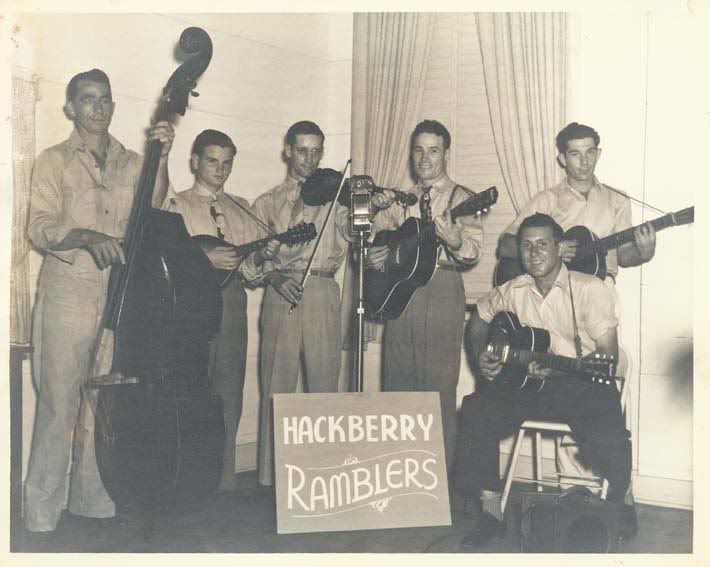
The Hackberry Ramblers are an influential Cajun group based in Hackberry, Louisiana, a small town in the southwestern portion of the state. The group was founded by fiddler Luderin Darbone (January 14, 1913 - November 21, 2008) and accordionist Edwin Duhon (June 11, 1910 - February 26, 2006) in 1933. While the group is famous for their interpretations of traditional Cajun music, they also perform western swing, blues, and rockabilly. Despite numerous changes in personnel over the years, the Hackberry Ramblers continue to perform to this day, surviving the passing of founding members Darbone and Duhon in 2008 and 2006, respectively.

"Dans Le Grand Bois" is a Cajun song that borrows the melody of "La Jolie Blonde," a song first recorded by Les Breaux Freres as "Ma Blonde Est Partie." The personnel of the Hackberry Ramblers on this recording is Luderin Darbone on fiddle, Floyd and Danny Shreve on guitars, and Pete Duhon on string bass and vocal. Whether Pete Duhon was a relative of Edwin Duhon or another name Edwin Duhon went by is not clear as of this writing. It is known that Edwin Duhon played guitar, bass, piano, and harmonica in addition to the accordion, so it is possible that Pete and Edwin Duhon are one and the same.

Moi, j'connais,
Ma 'tite fille.
T'es la bas dans l'grand bois tout seule.
Moi, j'm'en vas dans l'grand bois.
Avec ma fille.

Moi, j'connais,
Ma 'tite fille.
T'es la bas dans l'grand bois tout seule.
Moi, j'm'en vas dans l'grand bois.
Avec ma fille.


Many thanks to Neal Pomea for providing this transcription.

Unlike many of the Cajun selections on the original Anthology, which are primitive in the extreme, "Dans Le Grand Bois" reflects the influence of non-Cajun music, particularly country and western swing.

Pete/Edwin Duhon's lead vocal includes the distinctive vocal yelp towards the end of each line, so often associated with Cajun music.

According to Henry Wright, a fellow old time music enthusiast who also happens to be fluent in French (although admittedly not Cajun French),

The...lyrics seem to evoke a visit or a date in the woods. The parts I can make out, other than the title, which he repeats many times, are "la-bas" (over there), "ma petite fille" (my little girl) and "touts seuls" (all alone). To me this suggest the singer is telling us about a date or rendez-vous with a woman in a secluded spot, perhaps in or near the bayou, taking into account that it is a Cajun song.

Not having studied the language since high school, my French is extremely rusty. However, I do remember enough to recognize j'connais, which, as I recall, means I know; connais being the first person singular form of connaître, meaning to know or to be familiar with. The expression to know in English can have a sexual connotation (albeit in a fairly archaic manner). It seems to me, then, that if j'connais has a similar sexual connotation in French, that Dans Le Grand Bois is nothing less than a song about having sexual relations in the woods.

If "Dans Le Grand Bois" had appeared on the original Anthology, it would have appeared on the "Songs" volume. It would certainly not be the first or only salacious song included in Smith's collection.

The Shameless Plug Department: You can still become a fan of "Where Dead Voices Gather" on Facebook, however, and follow us on Twitter. Where Dead Voices Gather: Using today's technology to promote yesterday's music!

Remember that I still host "Doin' The Thing," a weekly jazz program on KRML 1410 AM and 94.7 FM in Carmel, California. The show airs from 8 PM to 10PM (Pacific Time) on Sunday nights. You can also listen online by visiting the KRML website at 8 PM Pacific, 11 PM Eastern Time. Please tune in and give me feedback!

Here's some film footage of the Hackberry Ramblers performing and talking about their history in the 1991 documentary, Marc and Ann, a film about Marc and Ann Savoy.


Download and listen to Hackberry Ramblers - "Dans Le Grand Bois (In The Forest)"

24 November, 2010

"Barbecue Bust" - Mississippi Jook Band


Set Four: The "Lost" Volume; Disc Two; Track Twelve: "Barbecue Bust" performed by Mississippi Jook Band. Recorded in Hattiesburg, Mississippi on July 20, 1936.

The Mississippi Jook Band was a one-off studio band consisting of Roosevelt Graves (guitar and kazoo), Uaroy Graves (tambourine) and Cooney Vaughn (piano). They recorded a handful of sides during this July, 1936 session, including this recording of "Barbecue Bust," recorded only thirteen days after "I'll Be Rested When The Roll Is Called" heard earlier on this disc.

For biographical information on Roosevelt and Uaroy Graves, see the entry for "I'll Be Rested When The Roll Is Called."

No biographical information is available on Cooney Vaughn. In his notes, Dick Spottswood quotes blues historian Gayle Dean Wardlow, who notes that Vaughn is "remembered as a pop performer, not a blues entertainer."

The group's name is a reference to "jook joints" or "juke joints," informal establishments where ordinary people (usually African Americans in the Deep South) congregated to drink, dance, gamble, and otherwise socialize. The term "juke" is believed to derive from the Gullah word "joog," which means "rowdy" or "disorderly." Such establishments first appeared on plantations in the Antebellum South as a place where slaves could socialize and unwind after a long week of work. The practice carried over into the post-Civil War era, often appearing in labor camps, and continued into Prohibition. It has been argued that juke joints represented the first "private space" accorded to blacks in the United States.

Juke joints demanded music, of course. Solo musicians and small groups would provide music for all night dancing (musicians such as Son House and Charlie Patton were veterans of the juke joints). When mechanization and recorded music proved a cheaper way to provide music, the juke joints lent their name to the automatic record playing machines installed in bars and other such establishments, which came to be known as "juke boxes."

"Barbecue Bust" is an almost entirely instrumental piece and is one of the only instrumental performances on the fourth volume of the Anthology. Had it appeared on the original three-volume Anthology, "Barbecue Bust" would have undoubtedly been featured on the first disc of the "Social Music" volume, along with other examples of dance music.

"Barbecue Bust" is an uptempo number, with strong ties to jazz and boogie woogie. The music is occasionally punctuated with cries and exhortations (at a couple of points, Cooney Vaughn is called upon by name). During the last verse, Roosevelt Graves engages in some scat singing. By 1936, scat singing could hardly be called "new," but it serves to solidly place this recording during the jazz age. In addition, Roosevelt Graves plays the kazoo during the first few verses, clearly emulating a jazz cornet. Cooney Vaughn's barrel-house piano ploughs a path through the song, despite being under-miked. Uaroy Graves, while not as prominent in this recording as he had been in "I'll Be Rested When The Roll Is Called", nevertheless lays down a driving rhythm that keeps this recording rolling straight through to the final bar.

"Barbecue Bust" gives us a glimpse of something close to the contemporary black music of the rural south during the late '30s. It is raucous and strident and anything but polite. It is also thoroughly of its time, which further serves to distinguish this volume from the rest of the Anthology.

"Barbecue Bust," like the previous entry, was recorded in Mississippi.

The Shameless Plug Department: You can still become a fan of "Where Dead Voices Gather" on Facebook, however, and follow us on Twitter. Where Dead Voices Gather: Using today's technology to promote yesterday's music!

Remember that I still host "Doin' The Thing," a weekly jazz program on KRML 1410 AM and 94.7 FM in Carmel, California. The show airs from 8 PM to 10PM (Pacific Time) on Sunday nights. You can also listen online by visiting the KRML website at 8 PM Pacific, 11 PM Eastern Time. Please tune in and give me feedback!

Speaking of boogie woogie piano, here's one of the grand masters, Meade Lux Lewis, in a "soundie" likely made during the 1940s...


Download and listen to Mississippi Jook Band - "Barbecue Bust"

20 November, 2010

"The Cockeyed World" - Minnie Wallace


Set Four: The "Lost" Volume; Disc Two; Track Eleven: "The Cockeyed World" performed by Minnie Wallace. Recorded in Jackson, Mississippi on October 12, 1935.

No biographical information on Minnie Wallace was available as of this writing. If anyone has any information to share, please leave a comment or e-mail me at wheredeadvoicesgather1@gmail.com.

Minnie Wallace was a known associate of the Memphis Jug Band, so it may be presumed that she lived and worked in Memphis, Tennessee for at least part of her career.

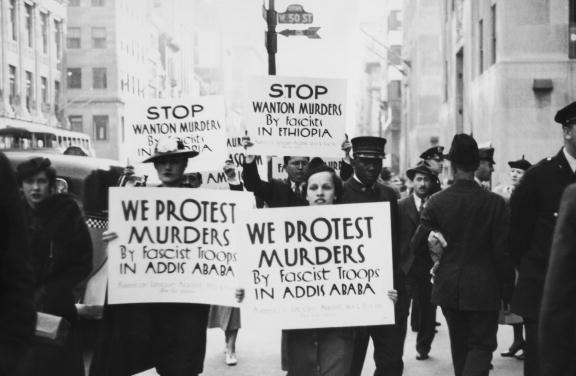
"The Cockeyed World" is a blues that makes reference to the Italian invasion of the Ethiopian Empire on October 3, 1935, just nine days before this recording was made.

Italian Fascist Dictator Benito Mussolini wanted to establish an Italian Empire to rival that of the Romans. He also sought to avenge the defeat the Italians suffered at the Battle of Adowa, which had ended the first Italo-Abyssinian War in 1896. In 1935, Ethiopia was one of only two independent nations in Africa. Subduing Ethiopia would strengthen Italy's imperialist presence on the continent.

The Italian invasion was brutal. The Ethiopian army, while larger than the invading Italian force, was armed with antique rifles (capable of firing only one shot), swords, knives, and spears. Many Ethiopian soldiers fought barefoot. The Italian forces consisted of approximately 595 planes and 795 tanks. The Ethiopian army, by contrast, had approximately three planes and as many tanks. Most controversially, on December 26, 1935, the Italian generals in charge of the invasion received permission to use mustard gas and other chemical warfare agents. The war was one-sided and extremely short. By the time Ethiopian Emperor Haile Selassie I had fled to British Palestine on May 4, 1936, approximately 275,000 Ethiopians were dead and more than 500,000 wounded.

On June 30th, Selassie addressed the League of Nations, asking for them to condemn the Italian invasion and support a resistance movement. He concluded by warning, "It is us today. It will be you tomorrow." The speech was a memorable one, and was viewed around the world via newsreel. But it failed to motivate the League of Nations to action. The League recognized Italy's sovereignty over Ethiopia, as did Nazi Germany, Imperial Japan, Great Britain and France. Only the United States, the Soviet Union, the Republic of China, Mexico, and New Zealand refused to recognize the legitimacy of Italy's invasion.

Italy occupied Ethiopia until 1941, when British forces retook Addis Ababa. Ethiopia was formally recognized as an independent nation in 1947 with the signing of the Treaty of Peace with Italy, and Emperor Selassie was restored as its ruler.

In the Americas, the Italian invasion of Ethiopia had a profound affect on people of African descent. As mentioned above, Ethiopia was one of only two independent nations in Africa. The invasion inspired strong feelings among black Americans as well as West Indians. Many black Americans volunteered to fight for Ethiopia, although few made it over there. In addition, it was during this period that the Rastafarian movement was born in Jamaica.

I woke up this morning feeling mighty bad.
'Twas the worst old feeling that I ever had.

It's war on Ethiopia and mama's feeling blue.
It's war on Ethiopia, mama's feeling blue.
I tell the cockeyed world, I don't know what to do.

They say that Ethiopia is a long ways from here.
They say that Ethiopia's a long ways from here.
They're trying to steal my man and carry him over there.

I love my man, tell the cockeyed world I do.
It's coming up tight but he sure loves me too.

This old cockeyed world will make a good man treat you mean.
This old [cock]eyed world will make a good man treat you mean.
He will treat you just like a poor girl he's never seen.

It's war on Ethiopia and the man overhead.
I tell the cockeyed world the things my baby said.

It's war on Ethiopia. Baby, please, please behave.
It's war on Ethiopia. Please, please behave.
I'll tell the cockeyed world, I'll follow you to your grave.

That's right.


"The Cockeyed World" is likely the most topical song on this already fairly topical volume of the Anthology, commenting as it does on world events that were transpiring even as the music was being committed to wax. It also points ahead to an event that was to come: The Second World War, an event that, along with the Great Depression, would effectively end the world of the Anthology. The United States would emerge from the crucible of war and economic turmoil an entirely different nation; a nation that would dominate the world as one of only two Super Powers; a nation that possessed the power to destroy all life on earth; a nation that would wield unprecedented political and economic influence over the globe, an influence that only today is beginning to recede.

The recording itself is ebullient, in stark contrast with the heavy lyrical content. Minnie Wallace's vocal is strong and rough, and is definitely of a piece with that of Memphis Minnie. Joining Wallace on this recording are Will Shade on harmonica, Ernest Lawlers on guitar, Robert "Tim" Wilkins on second guitar, Kid Stormy Weather on piano and "Spoons" on the spoons.

The Shameless Plug Department: You can still become a fan of "Where Dead Voices Gather" on Facebook, however, and follow us on Twitter. Where Dead Voices Gather: Using today's technology to promote yesterday's music!

Remember that I still host "Doin' The Thing," a weekly jazz program on KRML 1410 AM and 94.7 FM in Carmel, California. The show airs from 8 PM to 10PM (Pacific Time) on Sunday nights. You can also listen online by visiting the KRML website at 8 PM Pacific, 11 PM Eastern Time. Please tune in and give me feedback!

Here's a short video that describes the Italian invasion of Ethiopia and the galvanizing affect it had on American and West Indian blacks.


Download and listen to Minnie Wallace - "The Cockeyed World"

15 November, 2010

"He's In The Ring (Doing The Same Old Thing)" - Memphis Minnie


Set Four: The "Lost" Volume; Disc Two; Track Ten: "He's In The Ring (Doing The Same Old Thing)" performed by Memphis Minnie. Recorded in Chicago on August 22, 1935.

Memphis Minnie was born Lizzie Douglas in Algiers, Louisiana on June 3, 1897. She was the oldest of thirteen children born to Abe and Gertrude Douglas, both of whom earned a living as sharecroppers. In 1904, Douglas's family relocated to Walls, Mississippi. Around the same time, she received her first guitar as a gift and she began playing around the neighborhood. She would also sneak into nearby Memphis, Tennessee where she would play on the street and in public parks.

Around 1910, Douglas joined the Ringling Brothers Circus as a musician. She traveled all over the south with the circus before moving to the Bedford Plantation in Mississippi where she played with Willie Brown, a colleague and occasional performing partner of Charlie Patton's. During this period, Douglas began to establish a reputation as a first class blues performer, one of the few female blues musicians considered to be equal to (or even better than) the best male performers.

Before too long, however, Douglas returned to Memphis and began performing in the notorious Beale Street district. She had already proven herself a masterful blues musician, but living and working on Beale Street proved her toughness. She developed a reputation for hard drinking and gambling, and supplemented her income by working as a prostitute (charging the relatively exorbitant fee of $12 for her services, reportedly). Douglas also performed with the Memphis Jug Band during this period.

In 1929, Douglas made her first recordings for Columbia Records. Her first recording, "Bumble Bee" became a hit. It was on her first records that she was first credited as "Memphis Minnie," a name she continued to use for the rest of her career. She later recorded for other labels, including Decca and Bluebird, under the supervision of Lester Melrose. Among her other major contributions to the blues cannon, Minnie wrote "When The Levee Breaks" which was later recorded by Led Zeppelin.

Minnie was among the first generation of blues musicians to embrace the electric guitar, forming one of the first "classic" electric blues bands (consisting of electric guitar, bass, and drums). The sound Minnie helped pioneer lead the way for the Chicago blues musicians of the later '40s, including Muddy Waters, Howlin' Wolf, Little Walter, Willie Dixon, and Jimmy Rogers.

By the end of the 1950s, however, Minnie's music was considered unfashionable. Despite her use of electric instruments in performance, the more conservative record companies insisted that she record in her earlier style. She returned to Memphis in 1957. During this period, her health began to fail and she retired from performing. She spent the remainder of her life in a nursing home where she died from a stroke in 1973. She was buried in the New Hope Baptist Church Cemetery in Walls. Mississippi. A headstone was erected for her in 1996, largely paid for by guitarist Bonnie Raitt.

"He's In The Ring (Doing The Same Old Thing)" is an ode to the boxer Joe Louis (born Joseph Louis Barrow, 1914-1981). Joe Louis is widely considered to be one of the greatest heavyweight boxers of all time. Louis held the heavyweight title from 1937 to 1949, a total of 140 consecutive months. Recorded in 1935, "He's In The Ring" stems from relatively early in Louis's career, two years before he would win the heavyweight championship. Louis was a hero to African-Americans in the 1930s and 40s. While Louis defended his title numerous times during his long reign (more than any other champion since the bare-knuckle era), no fight of Louis's was as emblematic as his two bouts against the German fighter Max Schmeling. Louis and Schmeling fought on June 19, 1936 and again on June 22, 1938. Schmeling was held up as proof of Aryan superiority by Adolf Hitler and the Nazi Party. When Louis's first fight against Schmeling ended with Louis knocked out in the twelfth round. This was Louis only defeat by knockout during his prime. Poet Langston Hughes described the mood in Harlem following Louis's defeat:

I walked down Seventh Avenue and saw grown men weeping like children, and women sitting in the curbs with their head in their hands. All across the country that night when the news came that Joe was knocked out, people cried.


Louis met Schmeling a second time in 1938, after Louis had won the heavyweight championship. This time, Louis defeated Schmeling by a knockout in the first round. It was a major triumph for American blacks as well as a major setback for the Nazi image (the second such setback since Jesse Owens won four gold medals at the 1936 Berlin Olympic Games). Louis's victory helped to gradually defeat the myth of black inferiority.


Hey, you people going out tonight.
Let's go to see Joe Louis fight.
And if you ain't got no money,
Buddy (?), go tomorrow night.
'Cause he's in the ring doing the same old thing.

Well, he even carries a mean left.
You know he do!
And he carries a mean right.
And if he hit you with either one,
Sends the charge from a dynamite.
He's in the ring, boys, doing the same old thing.

I'm a-tell all of you prize fighters
Don't play Joe for no fool.
After he hits you with that left duke,
Same as a kick from a Texas mule.
He's in the ring, boys, doing the same old thing.

Joe Louis is a two-fist fighter.
And he stands six feet tall.
And the bigger they come,
He says, the harder they fall.
He's in the ring, oh! Doing the same old thing.

I'd chance my money with 'im!

For if I only had ten hundred dollars
And I laid up on my shelf.
I bet everybody passed my house
In one round Joe would knock 'em out.
He's in the ring, mmmmmmmmmmm! Doing the same old thing.

I wouldn't even pay my house rent.
I wouldn't buy me nothing to eat.
Joe Louis says, "Take a chance with me,
I'm gonna put (unintelligible) on your feet."
In the ring. He's still fightin'! Doing the same old thing!


"He's In The Ring (Doing The Same Old Thing)" is a blues masterpiece. Ably accompanied by Black Bob on piano and Bill Settles on bass, Memphis Minnie turns in a performance as powerful as one of Joe Louis's punches. Her voice is powerful, yet sensual, caressing the lyrics and lagging behind the beat. She makes frequent use of asides and exclamations, which add to the spontaneous feel of the recording. It is a highlight of the fourth volume in particular and of the Anthology as a whole.

This is also a performance that could not have appeared on the original three-volume Anthology. Like many of the ballads on volume one, "He's In The Ring" immortalizes a heroic figure in song. But unlike such figures as John Henry, Cole Younger, or Stackalee, Joe Louis is a figure set firmly in the present tense. All of the legendary figures on the original Anthology were dead and gone, but Joe Louis was somebody that a listener to this record could go see that very night. Blacks, as well as boxing fans of all colors, thrilled to Louis's exploits through newspaper reports and newsreels. Not only was Louis not dead, but his greatest deeds were yet to come.

Memphis Minnie was also far too contemporary a performer for the original Anthology. Her style was not only rooted in the classic country blues of the '20s, but it pointed towards the urban blues of the coming decade and rock and roll beyond.

"He's In The Ring (Doing The Same Old Thing)" is the first of two songs in a row that comment on current events that have nothing to do with the Depression and the first of two songs by a singer named "Minnie."

The Shameless Plug Department: You can still become a fan of "Where Dead Voices Gather" on Facebook, however, and follow us on Twitter. Where Dead Voices Gather: Using today's technology to promote yesterday's music!

Remember that I still host "Doin' The Thing," a weekly jazz program on KRML 1410 AM and 94.7 FM in Carmel, California. The show airs from 8 PM to 10PM (Pacific Time) on Sunday nights. You can also listen online by visiting the KRML website at 8 PM Pacific, 11 PM Eastern Time. Please tune in and give me feedback!

Unable to find a recent video of "He's In The Ring (Doing The Same Old Thing)" (always a risk with topical songs), we present a performance of a different Memphis Minnie tune. This is "Me and My Chauffeur Blues" performed by the East River String Band.


Download and listen to Memphis Minnie - "He's In The Ring (Doing The Same Old Thing)"